

Ave Maria (Hail Mary)
Image: »Francisco Rizi: Inmaculada«
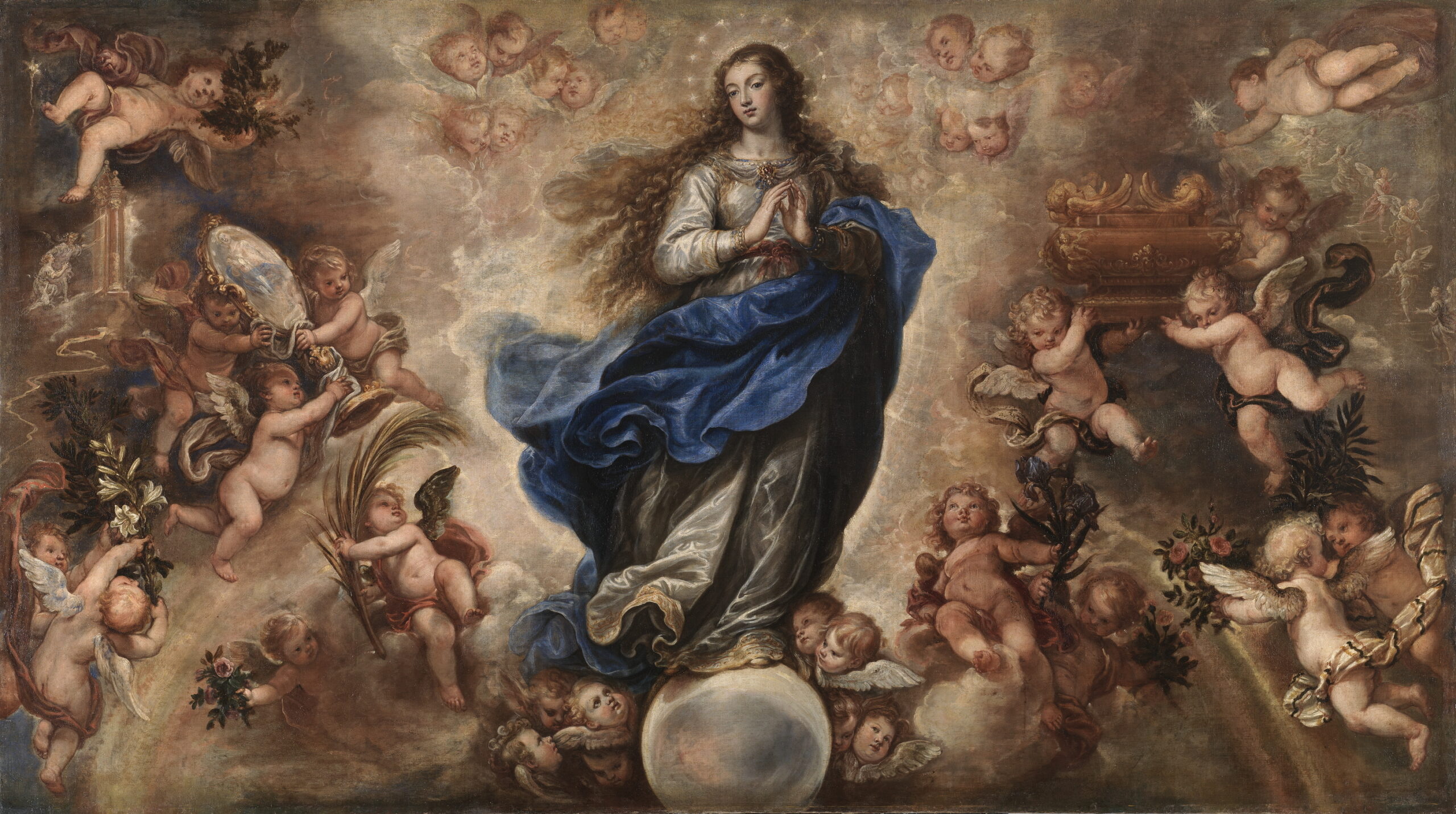
The Ave Maria is a Marian prayer addressed to the Virgin Mary that affirms her unique role as the mother of Jesus Christ and asks for her intercession. Its structure reflects a historical layering of Scripture-derived praise followed by a doctrinally grounded supplication that emerged over several centuries.
Text of the Prayer (Latin and English)
The full Latin and English texts of the Ave Maria, including interlinear translations, are available at latinprayer.org/prayers/ave-maria/.
That resource provides the standard wording used in Catholic liturgical and devotional contexts.
Origin and Historical Background
The opening lines of the Ave Maria originate directly from the New Testament, specifically the greeting of the angel Gabriel to Mary at the Annunciation (“Hail, full of grace, the Lord is with thee,” Luke 1:28) and the words of Elizabeth at the Visitation (“Blessed art thou among women, and blessed is the fruit of thy womb,” Luke 1:42). These verses were used independently in early Christian devotion as expressions of honor toward Mary.
By the early Middle Ages, these scriptural phrases were commonly combined into a single formula. The name “Jesus” was added later, likely between the 12th and 14th centuries, to clarify the Christological focus of the blessing. The final petitionary portion—asking Mary to “pray for us sinners, now and at the hour of our death”—developed in the late medieval period and was standardized in the Roman Catechism following the Council of Trent (16th century).
Theological and Scriptural Themes
The Ave Maria emphasizes several key theological themes. It affirms Mary’s status as “full of grace,” a phrase traditionally understood in Catholic theology as indicating her unique divine favor. The prayer is also Christ-centered, as it identifies Jesus as the “fruit” of Mary’s womb and grounds Marian honor in her relationship to him.
The petitionary section reflects the Catholic doctrine of the communion of saints, in which the faithful may ask saints, including Mary, to intercede with God on their behalf. Importantly, the prayer does not address Mary as a source of grace, but as one who prays for others.
Liturgical and Devotional Use
The Ave Maria is not part of the fixed texts of the Mass, but it is deeply embedded in Catholic devotional life. It forms the central repeated prayer of the Rosary and is also used in the Angelus, the Regina Caeli (during Eastertide), and various paraliturgical contexts. It is frequently recited privately, memorized early in catechesis, and incorporated into communal prayer services.
Musical settings of the Ave Maria—notably those by composers such as Schubert, Gounod, and Palestrina—have further contributed to its prominence in both sacred and cultural contexts, though these settings vary in textual fidelity.
Role in Catholic Life and Practice
Within Catholic practice, the Ave Maria functions as both a prayer of biblical praise and a concise expression of trust in intercessory prayer. Its long historical development illustrates how Scripture, doctrine, and devotion interact over time, and its continued use reflects its enduring role as a foundational element of Catholic prayer and identity.