The Nicene Creed
Image: »The Same Divine Light«
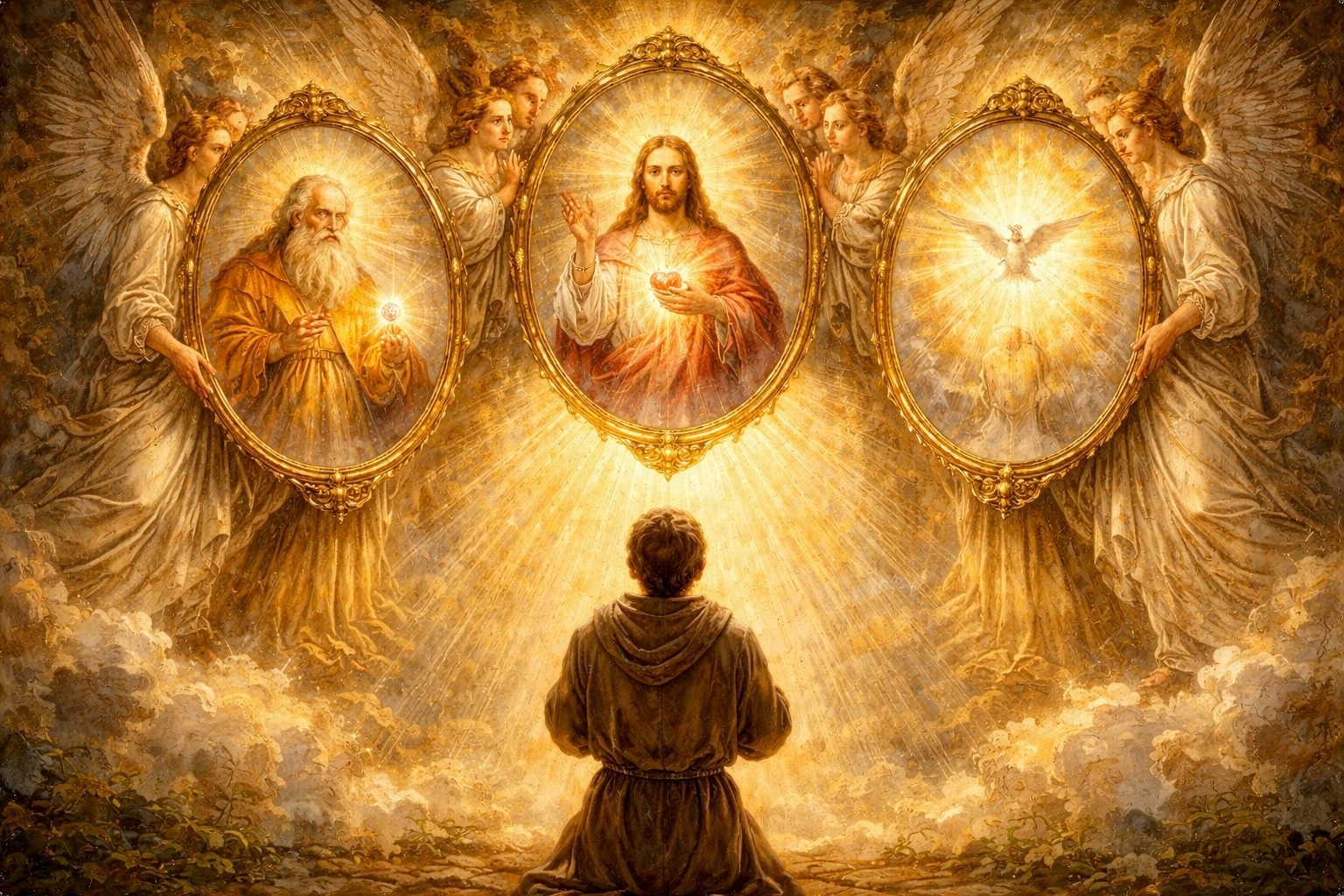
The Nicene Creed is a formal statement of Christian belief that articulates the Church’s teaching on the Trinity, the divinity of Christ, and the work of salvation. It serves as a doctrinal standard in Catholic theology and a communal confession of faith within the liturgy.
Text of the Prayer (Latin and English)
The standard Latin text (Symbolum Nicaenum-Constantinopolitanum) and approved vernacular translations are not reproduced here. The complete text, with aligned Latin and modern-language versions, may be read at:
https://latinprayer.org/prayers/nicene-creed/ :contentReference[oaicite:1]{index=1}
Origin and Historical Background
The Nicene Creed developed through two ecumenical councils of the early Church: the :contentReference[oaicite:2]{index=2} and the :contentReference[oaicite:3]{index=3}.
The original creed of 325 was composed to counter Arianism, a doctrine denying the full divinity of Jesus Christ. The text was later expanded in 381 to clarify teachings on the Holy Spirit and to produce the form substantially used today. Its authority rests on conciliar consensus rather than private devotion.
Theological and Scriptural Themes
The creed is structured trinitarianly, professing faith in the Father, the Son, and the Holy Spirit. Central theological affirmations include the consubstantiality of the Son with the Father (homoousios), the incarnation “for us and for our salvation,” and the Church’s expectation of resurrection and eternal life.
Its formulations draw heavily on Scripture, synthesizing biblical language from both Testaments into precise theological definitions intended to safeguard orthodox belief.
Liturgical and Devotional Use
In the Roman Rite, the Nicene Creed is recited or sung during Mass on Sundays and solemnities following the homily. Its use is strictly liturgical and doctrinal rather than private or devotional.
The creed also functions catechetically, forming a structural basis for theological instruction and baptismal preparation within the Church.
Role in Catholic Life and Practice
Within Catholic life, the Nicene Creed stands as a unifying expression of belief shared across cultures and centuries. By preserving the Church’s doctrinal memory in concise form, it continues to shape Catholic identity, worship, and theological continuity in every generation.