

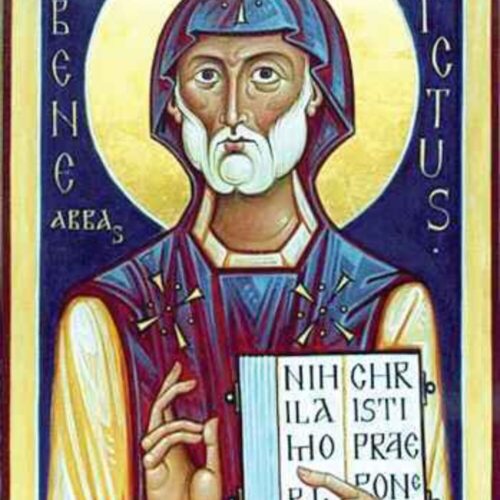
Benedict of Nursia
Saint Benedict is invoked against poison and protected from it because of two incidents in his life recorded by Saint Gregory the Great: jealous monks tried to poison his wine, but when he blessed the cup it shattered; and when bread was poisoned, a raven carried it away at his command. From these stories comes the famous Saint Benedict Medal, whose initials spell a prayer against the devil and his poisons — which is also why he is invoked against temptation. As father of Western monasticism and author of the Rule, he is the patron of monks; students claim him for the learning his monasteries preserved through the Dark Ages, engineers and farmers for the labor his “Ora et Labora” sanctified. Pope Paul VI proclaimed him patron of all Europe, whose Christian civilization his monks rebuilt.
Saint Benedict of Nursia is the father of Western monasticism. Born around 480 in central Italy, he founded the famous monastery of Monte Cassino and wrote the Rule of Saint Benedict, which became the foundation for monastic life in the West. His motto “Ora et Labora” (Pray and Work) has guided religious communities for fifteen centuries.