

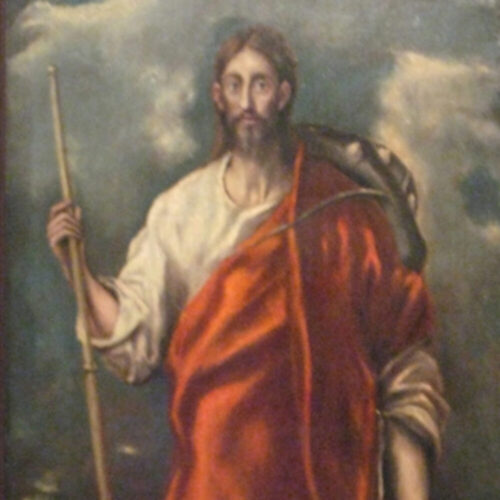
James the Greater
Saint James the Greater is the patron of pilgrims because his shrine became the goal of the greatest pilgrimage of the Middle Ages: tradition holds that his body was carried to Galicia and rediscovered at Santiago de Compostela, and across the centuries countless pilgrims walked the Camino to his tomb, wearing the scallop shell that is still his emblem. From those staff-bearing, shell-wearing wayfarers he is also the patron of pharmacists and laborers and of all who travel hard roads. He is the patron of soldiers and of Spain under the title Santiago Matamoros — “Saint James the Moor-slayer” — from the legend that he appeared on horseback to aid the Christian armies of the Reconquista; he is invoked against arthritis and rheumatism, the aches of the long-distance walker. As an apostle and son of Zebedee, he and his brother John were the fishermen Christ summoned from their nets (Matthew 4:21-22).
Saint James the Greater was one of the first apostles called by Jesus, the son of Zebedee and brother of John. He was present at the Transfiguration and in the Garden of Gethsemane. He was the first apostle to be martyred, beheaded by King Herod Agrippa around 44 AD. His relics are venerated at Santiago de Compostela in Spain.